
How to Design An Effective Patient Scheduling Workflow for Complex Specialties

Specialty care scheduling requirements are different from regular procedures and often demand a structured system in place, one that matches patient needs with the right provider, at the right time, and ideally, with minimal friction. Different from primary care, specialty scheduling depends on clinical protocols, resource availability, and coordination across teams..
In complex specialties such as radiology, gastro, ortho and oncology, or interventional procedures, scheduling must account for:
- Specific exam or procedure protocols
- Equipment availability and prep time
- Provider subspecialization
- Insurance and authorization requirements
- Patient readiness and instructions
Large health systems can manage thousands of unique visit types, making scheduling standardization difficult but necessary.
So this is where most workflows break down often due to workflows not being designed for complexity.
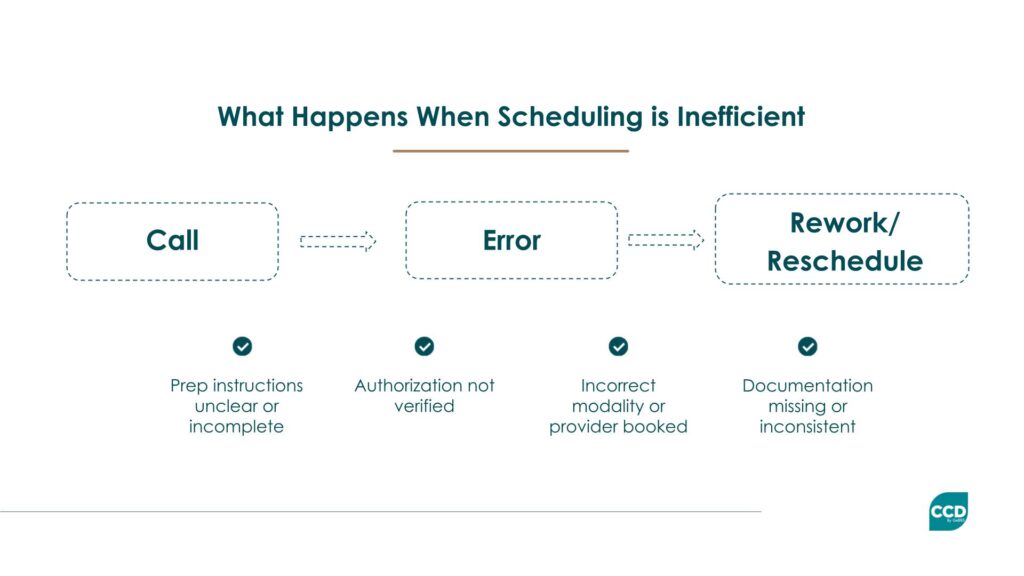
What an Efficient Scheduling Workflow Looks Like for Complex Specialties
A strong specialty care scheduling workflow follows a clear structure from first contact to appointment confirmation.
1. Structured Patient Intake
Every workflow starts with accurate intake that down the line can prevent delay care and revenue issues. This means capturing:
- Reason for visit
- Clinical indications
- Referring provider information
- Insurance and eligibility
2. Smart Triage and Protocol Matching
Once intake is complete, the next step is triage. In this step the goal is simple: match the patient to the correct procedure, provider, and location. But in complex specialties, this is where most scheduling errors happen.
In our last webinar, our director of training broke down how protocol-driven workflows reduce scheduling errors and improve outcomes (both operational and financial) across specialty care.
3. Real-Time Scheduling
Specialty workflows must consider:
- Equipment constraints
- Prep time and room turnover
- Provider schedules
- Procedure sequencing
Advanced scheduling models can reduce patient wait times and improve resource utilization, especially when automation is introduced.
This is where traditional call center scheduling often falls short because it lacks the logic needed to handle complexity at scale.
4. Patient Communication and Preparation
Patient communication plays a huge role in how specialty scheduling workflows actually perform.
Because while booking the appointment only solves part of the problem, what happens between scheduling and the visit determines whether the patient shows up prepared, shows up at all, or abandons it entirely. In complex specialties, preparation requirements vary a lot and missing a single instruction can lead to what we mentioned earlier. No-shows, wasted capacity.
Standardized scripts help create that consistency across teams. They guide schedulers through what needs to be explained, how to explain it, and when to reinforce key details such as prep instructions, documentation, and timing expectations. During our webinar last month, we also covered how organizations using structured communication workflows reduce variability across agents and improve patient compliance. When every patient receives the same clear guidance, teams spend less time correcting issues later, and schedules stay intact.
5. Continuous Optimization Using Data
Strong scheduling workflows improve over time through continuous feedback and adjustment. Every interaction generates data that can reveal where friction exists, whether in intake accuracy, scheduling speed, or appointment utilization.
So, instead of relying on assumptions, high-performing teams track metrics such as no-show rates, time to schedule, reschedule frequency, and slot utilization to identify gaps and prioritize improvements.
For example, patterns in no-shows can inform overbooking strategies or targeted outreach. Delays in scheduling can highlight bottlenecks in intake or authorization processes. Over time, small adjustments compound into meaningful gains in access, productivity, and revenue. Teams that treat scheduling as a measurable system, rather than a fixed process, consistently outperform those that do not.
If you are looking to improve how your organization handles specialty care scheduling, it starts with the right workflow. Discover how CCD Health can help you optimize patient access operations, reduce no-shows, and build scalable scheduling systems that actually work.