
What a Patient Scheduling Solution Should Include in 2026

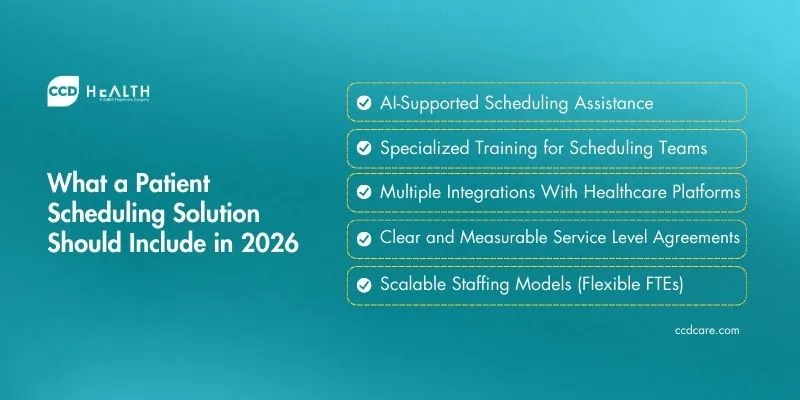
A patient scheduling solution in 2026 should include:
- AI-assisted scheduling support
- Specialized schedulers
- Multiple integrations with healthcare systems
- Clear service level agreements (SLAs)
- Scalable staffing models that can adjust to fluctuating patient demand.
All these elements can help healthcare organizations manage appointment volumes efficiently, reduce operational strain on staff, and improve both patient access and financial performance.
Healthcare operations leaders know that scheduling went from being an admin task, to be a revenue driver that conditions almost all front-end RCM.
Scheduling is then: an access point for care, and a key part of patient experience and because of this, patient scheduling solutions in 2026 must go beyond answering calls. They must support operational efficiency, provide visibility into performance, and adapt to growing patient demand and appointment complexity.
Below, we list the core elements healthcare organizations should expect from a modern patient scheduling solution:
1. AI-Supported Scheduling Assistance
In our opinion, this is one of the key areas where healthcare ops should focus AI implementations. In scheduling environments, AI helps teams manage high call volumes, improve accuracy, and reduce manual workload.
How? AI support enhances their ability to process information quickly and guide patients through the scheduling process.
A modern patient scheduling solution should include AI tools that can:
- Assist agents with protocol guidance for scheduling specific procedures
- Identify the most appropriate appointment slots based on patient needs and provider availability
- Help predict no-show risk and recommend scheduling adjustments
- Support call summarization and documentation
These capabilities help reduce scheduling errors while allowing staff to focus on patient communication rather than administrative steps.
On the other hand, it also helps healthcare organizations analyze scheduling data more effectively. Over time, these insights can reveal trends related to appointment demand, no-show patterns, and provider utilization. With better visibility into scheduling performance, healthcare operations teams can make smarter decisions about capacity planning and patient access strategies.
2. Specialized Training for Scheduling Teams
Because technology alone cannot solve scheduling challenges, then it is up to the people responsible for patient interactions to be properly trained to handle and know healthcare workflows, clinical terminology, and patient communication.
In 2026, healthcare organizations should expect scheduling partners to provide structured training programs that prepare schedulers for complex modalities, billing, denial claim management, prior auth and above all, to guide the patient or give the right information at the right time. .
Effective training includes:
- Medical terminology and procedure/specialty familiarity
- Insurance and referral verification basics
- Appointment type differentiation
- Call handling best practices
- HIPAA compliance and patient privacy standards
- Empathy and service disposition
Specialized schedulers are able to guide patients through complex scheduling processes and maintain accuracy and professionalism at the same time.
Training also plays an important role in improving operational metrics. When agents understand scheduling protocols and system workflows, average handle time decreases and first-call resolution improves.
Healthcare organizations should look for scheduling solutions that invest in continuous education and performance coaching. As healthcare services evolve and new procedures are introduced, scheduling teams must remain up to date.
3. Multiple Integrations With Healthcare Platforms
Healthcare scheduling operates within a broader technology ecosystem that includes electronic health records (EHR), practice management systems, and communication platforms.
Without strong integrations, scheduling teams often face fragmented workflows that slow down operations and increase errors.
An efficient patient scheduling solution should integrate with systems such as:
- Electronic health records (EHR)
- Practice management platforms
- Referral management tools
- Patient communication systems
- Revenue cycle platforms
These integrations allow scheduling teams to access the information they need in real time.
For example, integrated systems can help agents verify patient records, confirm referral requirements, and ensure appointment slots match provider availability.
From an operational standpoint, integrations also improve reporting capabilities. Healthcare leaders can track scheduling performance, appointment utilization, and patient access metrics across multiple locations or service lines.
4. Clear and Measurable Service Level Agreements
Service level agreements ensure accountability within patient scheduling operations.
In healthcare environments, access delays directly impact patient outcomes and revenue, that’s why organizations need clear expectations around performance.
A reliable scheduling solution should define measurable SLAs related to patient access and operational efficiency.
Common SLA metrics include:
- Call answer time
- Call abandonment rate
- Appointment conversion rate
- Scheduling accuracy
- First-call resolution
- Average handle time
Six metrics that give healthcare administrators a clear understanding of how scheduling operations are performing.
SLAs also support transparency. When expectations are documented and measured consistently, healthcare organizations can quickly identify performance gaps and address them before they affect patient access.
But strong SLAs also help align scheduling operations with broader organizational goals like appointment leakage reduction, patient experience improvements, and provider utilization rates.
5. Scalable Staffing Models (Flexible FTEs)
Healthcare demand rarely remains constant. Appointment volumes fluctuate due to seasonal demand, marketing campaigns, provider expansions, and public health trends.
Because of this, patient scheduling solutions must provide scalable staffing models that allow organizations to adjust capacity when needed.
Flexible full-time equivalent staffing allows healthcare organizations to increase or decrease scheduling resources without the delays associated with internal hiring.
This flexibility is especially relevant when there are:
- Seasonal increases in patient demand
- Service line expansions
- New provider onboarding
- Large community screening campaigns
- Unexpected surges in appointment requests
Scalable staffing models help organizations maintain consistent service levels without overextending internal teams.
On the financial side, instead of maintaining excess staffing capacity year round, organizations can align scheduling resources with actual demand.
The result is improved operational efficiency and better control over labor costs.
Effective patient scheduling requires the right combination of technology, trained staff, and operational structure. When these elements work together, healthcare centers can improve access, reduce administrative burden, and protect revenue from missed appointments.
For healthcare leaders, investing in a modern patient scheduling solution is not just about answering calls. It is about creating a structured, data-driven access system that supports both patient care and organizational performance.
If your organization is exploring ways to strengthen patient access operations, discover how CCD Health’s patient scheduling solutions can support your team with a scalable scheduling model, AI-powered workflows and structured performance standards.