
6 Strategies to Improve Multi-Location Patient Scheduling

Improving multi-location patient scheduling comes down to 6 core strategies:
- Standardizing workflows
- Aligning scripts,
- Creating shared visibility across locations,
- Leveraging AI support,
- Defining clear routing rules, and
- Managing performance consistently.
When these are in place, scheduling becomes faster, more accurate, and easier to scale across every location. In this article, we break down exactly how to implement each one in a way that works in real healthcare operations.
Why Is Multi-Location Patient Scheduling Complex To Manage?
Complexity starts with each location often developing its own process, which creates inconsistency and inefficiency.
Those differences show up in small ways at first. One team asks different intake questions. Another schedules more aggressively. Another gives incomplete instructions. Over time, those inconsistencies lead to reschedules, longer call times, and uneven patient experiences.
The issue is not volume itself, but lack of alignment in how it’s handled.
What Are The Most Effective Ways To Improve Multi-Location Scheduling?
Multi-location scheduling improves when it is treated as a single operation with shared rules, not as separate tasks handled by each site.
In our experience and after helping our clients double and improve their scheduling operations across different locations, that means building consistency into:
- How appointments are scheduled
- How patients are spoken to
- How availability is used
- How decisions are made during scheduling
- How performance is measured
The 6 strategies we recommend in this article focus on exactly that.
1. Standardizing Scheduling Workflows
Providers can standardize workflows by defining a single scheduling process that every team follows.
Even for complex specialties like gastro, ortho, and imaging, a well-designed workflow can make or break an entire RCM performance.
What should a standardized workflow include?
It should include every step from intake to confirmation. That means:
- Patient intake and verification
- Visit or procedure selection
- Provider and location matching
- Appointment booking
- Pre-visit instructions
This removes guesswork and reduces variation across locations.
How do you ensure teams follow the same workflow?
By embedding workflows into daily operations and reinforcing them through training, which includes:
- Making sure all your tools and processes (EHR and scheduling, for example) integrate without disrupting your operations
- Training all schedulers on specific and standardized processes
- Using QA reviews and call audits
- Building workflows into scheduling systems
- Measuring adherence, not just outcomes
2. Standardize Scheduling Scripts
You should standardize scripts to ensure every patient interaction is clear, accurate, and consistent.
What should scheduling scripts cover?
They should guide the entire conversation while allowing for a natural tone.
A strong script includes:
- Opening and verification language
- Key intake questions
- Decision prompts for scheduling
- Appointment confirmation details
- Pre-visit instructions
How do scripts improve scheduling outcomes?
They reduce variability and improve communication, which over time leads to:
- Fewer errors in scheduling
- Better prepared patients
- Reduced reschedules and cancellations
- More efficient call handling
3. Create Visibility Across Multiple Locations
Providers can achieve this by giving schedulers access to real-time availability across all sites.
Why is shared visibility important?
It allows schedulers to offer better options and optimize capacity. With full visibility, teams can:
- Redirect patients to available locations
- Reduce appointment delays
- Balance provider schedules
How do you implement this effectively?
Using a system that unifies scheduling data across locations. Centralized scheduling offers the most benefits cause does exactly that, allowing any scheduler to confidently book appointments regardless of location.
![Centralized Scheduling for Healthcare Centers [Complete Guide] banner - includes healthcare team in medical setting](http://ccdcare.com/wp-content/uploads/2026/04/CCD-GeBBs-banners.webp)
4. Leverage AI-Powered Scheduling Tools
AI-powered tools improve accuracy by guiding how appointments are matched and scheduled in real time.
AI can recommend the correct appointment type based on patient inputs, match patients to the right provider and time slot, and flag missing or inconsistent information before the booking is completed. This reduces errors that typically come from manual interpretation, especially in more complex scheduling scenarios.
How do These Tools Support Schedulers?
It acts as a decision support layer that helps schedulers move faster and with more confidence.
During interactions, AI can:
- Surface the best available options instantly
- Prompt the next step in the workflow
- Highlight important requirements tied to specific visits or procedures
This is especially valuable for newer staff or when handling less common appointment types.
5. Smart Patient-Routing
You route patients using predefined rules that match patient needs with the right provider and site.
What should routing rules consider?
They should consider both clinical and operational factors. This includes:
- Type of visit or procedure
- Provider availability
- Equipment or specialty requirements
- Patient location and preferences
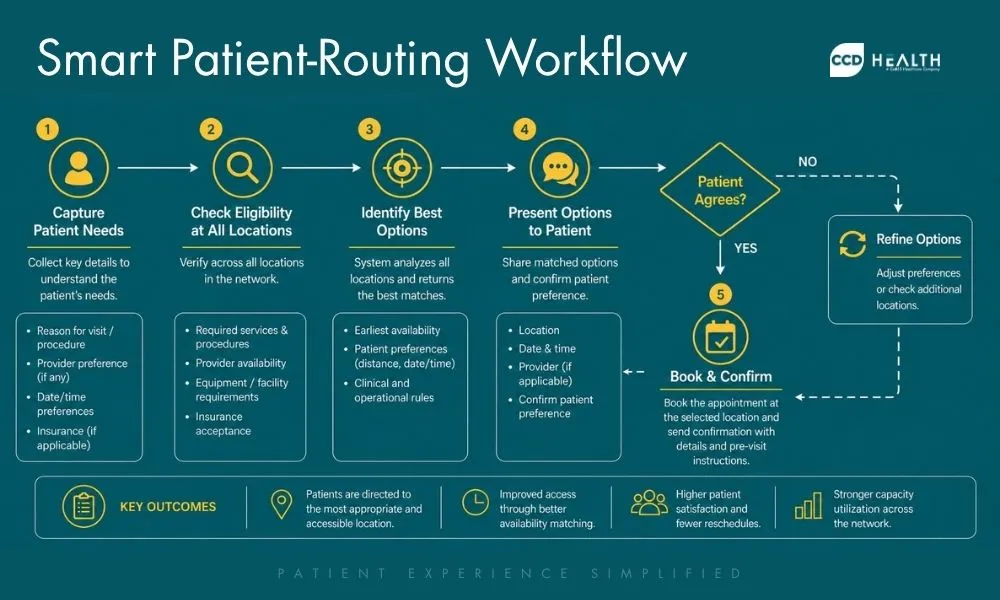
Clear rules remove uncertainty and improve decision-making, and ensure patients are scheduled correctly the first time.
6. Aligning Performance Management Across Teams
The most effective way to do this is by aligning performance metrics, training, and accountability across all locations.
Ideal metrics to track:
You should track both efficiency and quality (standardized) metrics, like:
- Call handling time
- Scheduling accuracy
- Appointment lead time
- No-show rates
- Conversion from inquiry to appointment
How do you align teams around these metrics?
Make performance visible and actionable. That includes:
- Shared dashboards
- Regular performance reviews
- Coaching based on real interactions
- Clear expectations across locations
When workflows are clear, communication is aligned, smarter tools support decisions, access is optimized across locations, and performance is managed as one operation, scheduling becomes predictable and scalable.
Discover how CCD Health helps healthcare providers improve multi-location scheduling with structured workflows, trained teams, and scalable patient access solutions.