
How to Design An Effective Patient Scheduling Workflow for Complex Specialties

Designing patient scheduling workflows for complex specialties starts with one thing: putting the right structure in place from the very first interaction. Healthcare teams need a system that captures the right details, routes patients correctly, and supports scheduling decisions without guesswork. When that structure exists, scheduling becomes faster, more accurate, and easier to scale.
To Design An Effective Patient Scheduling Workflow for Complex Specialties:
- Structure Patient Intake
- Set Smart Triage and Protocol Matching
- Use Real-Time Scheduling
- Improve Patient Communication and Preparation
- Monitor Performance and Use Data to Inform Optimizations
These five components help teams handle the real complexity behind specialties like radiology, gastroenterology, orthopedics, oncology, and interventional procedures. Every appointment depends on protocols, equipment, prep requirements, provider expertise, and insurance details. When workflows account for all of that upfront, teams spend less time fixing mistakes and more time moving patients through the system efficiently.
What an Efficient Scheduling Workflow Looks Like for Complex Specialties
A strong specialty care scheduling workflow follows a clear structure from first contact to appointment confirmation.
1. Structured Patient Intake
Every workflow starts with accurate intake that, down the line, can prevent delayed care and revenue issues. This means capturing:
- Reason for visit
- Clinical indications
- Referring provider information
- Insurance and eligibility
In this context, a specialized scheduling team for radiology, orthopedics, oncology, and other specialties can really make a difference when it comes to doing efficient intake and improving first call resolution.
2. Smart Triage and Protocol Matching
Once intake is complete, the next step is triage. In this step the goal is simple: match the patient to the correct procedure, provider, and location. But in complex specialties, this is where most scheduling errors happen.
In our last webinar, “Improving Complex Scheduling with Training and AI-Enabled Support”, our director of training broke down how protocol-driven workflows reduce scheduling errors and improve outcomes (both operational and financial) across specialty care.
3. Real-Time Scheduling
Once intake and triage are done, the system must translate that information into an actual appointment that fits both clinical and operational context of your center. Relying on open calendar slots alone creates mismatches that lead to delays, reschedules, or idle resources.
Specialty workflows must consider:
- Equipment constraints
- Prep time and room turnover
- Provider schedules
- Procedure sequencing
Advanced scheduling models can reduce patient wait times and improve resource utilization, especially when automation is introduced.
This is where traditional scheduling often falls short for Healthcare Providers, because it lacks the logic needed to handle complexity at scale.
4. Patient Communication and Preparation
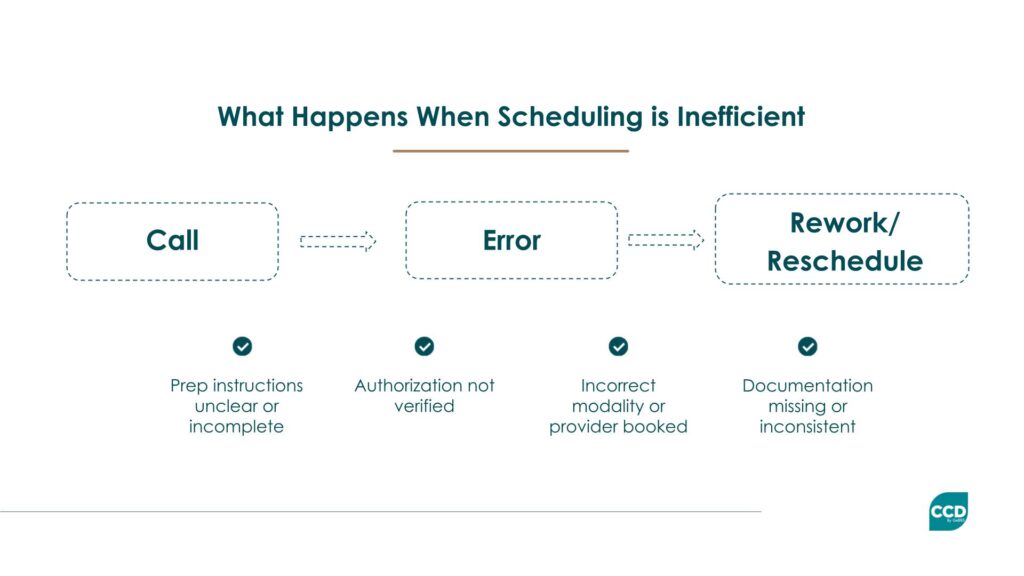
Booking the appointment only solves part of the problem; what happens between scheduling and the visit determines whether the patient shows up prepared, shows up at all, or abandons it entirely. In complex specialties, preparation requirements vary a lot and missing a single instruction can lead to what we mentioned earlier. No-shows, wasted capacity.
Standardized scripts help create that consistency across teams. They guide schedulers through what needs to be explained, how to explain it, and when to reinforce key details such as prep instructions, documentation, and timing expectations. During our webinar last month, we also covered how organizations using structured communication workflows reduce variability across agents and improve patient compliance. When every patient receives the same clear guidance, teams spend less time correcting issues later, and schedules stay intact.
_________________________________________________________
Take a closer look at how CCD Health simplifies complex specialty scheduling and helps your team operate more efficiently.

_________________________________________________________
5. Continuous Optimization Using Data
Strong scheduling workflows improve over time through continuous feedback and adjustment. Every interaction generates data that can reveal where friction exists, whether in intake accuracy, scheduling speed, or appointment utilization.
So, instead of relying on assumptions, high-performing teams track metrics such as no-show rates, time to schedule, reschedule frequency, and slot utilization to identify gaps and prioritize improvements.
For example, patterns in no-shows can inform overbooking strategies or targeted outreach. Delays in scheduling can highlight bottlenecks in intake or authorization processes. Over time, small adjustments compound into meaningful gains in access, productivity, and revenue. Teams that treat scheduling as a measurable system, rather than a fixed process, consistently outperform those that do not.
If you are building or redesigning scheduling workflows for specialty care, focus on these principles:
- Standardize What You Can: Not every visit type needs full customization. Start with high-volume services.
- Embed Clinical Logic into Scheduling: Schedulers should not guess; they should have the tools that guide them.
- Centralize Patient Access: A unified access model improves consistency and reduces delays.
- Use Technology as Support: AI and automation should enhance decision-making while keeping human oversight.
- Measure and Improve.
Having scheduling workflows for specialty care in place can help multi-location and multi-specialty centers handle complexity without slowing down operations.
When done right, these are the same workflows responsible for improving patient access, reducing scheduling errors, increasing provider productivity, driving measurable revenue impact, and most importantly, creating a better experience for both patients and staff.
If you are looking to improve how your organization handles specialty care scheduling, it starts with the right process. Discover how CCD Health can help you optimize patient access operations, reduce no-shows, and build scalable scheduling systems that actually work.